Welcome to GO GREEN..BE GREEN..GREEN LIVING EXPLORED

Within this blog we will explore the hints, tips and techniques of living green in our own personal lives.

We are going to take a more conservative approach to Green Living. No, we don't have to become good little Republicans! We just need to take personal responsibility for ourselves and our community, and not re lie on the government to save the day.

Please, Please, Please!! There will be NO finger pointing and name calling here. There are 100's of other blogs and websites that have that covered. Finger pointing and name calling may make us feel good for the moment, but it has never helped solve one problem.

We will be helping each other to live the green life as best as possible. In turn we can help or friends, family and community. One little step at a time will make a big difference. So lets get started.

Friday, November 1, 2013

Living Green 365: Leaves

Having trouble viewing this message? View it as a webpage.

Living Green 365

All those Autumn leaves

Peak fall color has passed for most of the state and leaves are slowly falling. Wherever they fall, they decompose and restock the soil with nutrients and organic matter.

But when there is no soil to land on--such as on a street or sidewalk--the leaves, and all the decomposing bits, wash down the street and into the storm drain. They go directly into lakes and rivers where the nutrients will feed unwanted algae growth next summer. In addition to a major "ick" factor, this algae is a problem because when it dies and decomposes at the bottom of the lake it uses up oxygen that fish and native plants need.

In the Mississippi River-Twin Cities watershed 87 of the 180 lakes studied didn't meet water quality standards because of excess nutrients--that's about half the lakes! And leaves are a major source of the problem. Depending on the lake, leaves might account for 60% of the excess nutrients in these lakes.

Don't "leaf" it up to someone else to solve this problem! Here's what to do with your autumn leaves so that they nourish the soil and not unwanted algae.

Rake

Rake the leaves that have accumulated along your curb, sidewalk, and alley

Several times during the fall, rake up the leaves that have accumulated along your curb and sidewalk. Street sweeping in late fall helps keep a lot of leaves from entering the water. If your city doesn't already do this, encourage them to start! By the time the street sweepers drive by, however, lots of decomposition and several rain storms may have occurred. You can help by raking 1-2 additional times. If you work with youth or community groups, consider organizing a community clean up for water quality to do this for others. Never rake leaves into the street, even when you know the street sweeper is coming.

Fire

Never trash or burn your leaves

Don't add leaves to the regular trash (it's illegal!) and don't burn them. Burning leaves releases large amounts of air pollution. These pollutants can cause breathing problems for sensitive groups and lead to long-term health effects for all of us.

Compost bin

Put leaves in your backyard compost pile

One of the best ways to use leaves (from the street or the yard) is to compost them in your backyard. Read how to compost on the MPCA website. My backyard bin isn't big enough to accommodate all our leaves, so I usually put early and late season leaves in the bin and then on my main raking weekend I bring the rest to a compost or yard waste drop-site (see below). If you have room, also bag up and store some dry leaves to use a carbon source ("browns") in your compost pile during the coming year. If you don't plan to use your finished compost in the spring, consider connecting with people who would like to use it on the Yards to Gardens website.

garden-mulch

Use leaves to mulch your garden and lawn

Whole or shredded leaves can be used as mulch. Mulch benefits the soil and reduces weeds. On the lawn, use a mower to break apart the leaves so that they fall between the blades of grass (consider using an electric mower, since two-cycle gas lawn mowers, especially older models, produce large amounts of air pollution). Don't let the leaf layer get too thick! In garden beds, leaves provide a protective layer of insulation for perennial gardens and shrubbery, either bagged or loose. Read these additional tips for mulching from Minnesota Extension.

compost site

Drop leaves off at a compost site

Another option is to drop off your leaves and sticks at a compost site near you. Depending on where you live, these may be called "yard waste" or "brush" drop sites. Contact your city or county for drop-off site locations, items accepted and any fees involved. 

Curbside

Consider curbside pick-up if you want a convenient option

Your garbage hauler may separately collect yard waste--sometimes for an additional fee--and then bring it to a commercial compost site. Contact your garbage hauler to learn about your pick-up options.

Be aware that residents in the Twin Cities area who bag their yard and organic waste are required to put their waste out for pickup in compostable bags--either paper bags or compostable plastic bags. This law applies to residents in Anoka, Carver, Hennepin, Ramsey, Scott, and Washington counties. Learn more about the compostable bag requirements on the Rethink Recycling website.

Play

Play in your leaf pile

Before bagging or moving the leaves,  jump in them! Inhale deeply. Share your pile by leaving it on the lawn near the sidewalk for a few days with chalk note that says, "jump!" There are tons of benefits to playing outside including boosting vitality; improving vision; reducing risks of heart disease, obesity, bone problems, depression, and stress; reducing the symptoms of attention deficit hyperactivity disorder; and more.


Community events and resources

I Recycle!

Celebrate America Recycles Day on November 15 by posting this icon on Facebook. You probably already know you can recycle cans, bottles, paper and some other things. But how about... mattresses? Holiday lights? Carpet? Toilet paper tubes? On Recyclemoreminnesota.org you can learn how even unusual materials can avoid the landfill and benefit Minnesota's economy and environment through recycling.

Join us, and 70 other vendors, at the 8th Annual Green Gifts Fair. The MPCA and Junket: Tossed and Found are teaming up to demonstrate ideas for re-gifting, including a fun make-and-take memory book activity, Saturday, November 23, 10 a.m.-5 p.m., Midtown Global Market (Minneapolis).

The average household in St. Paul wastes almost $100 worth of food every month. The holidays can be even more wasteful. To help you reduce food waste, we've pulled together a list of tips and resources. Check it out!


Thank you for reading Living Green 365. This newsletter is a publication of the Minnesota Pollution Control Agency. Please send questions or comments about living green to the address below.

Sincerely,

Britt Gangeness and the Living Green Team   

livinggreen365.pca@state.mn.us    


This email was sent to stan6637.gogreen@blogger.com using GovDelivery, on behalf of: Minnesota Pollution Control Agency 
520 Lafayette Road North · Saint Paul, MN 55155 · 1-800-439-1420

Monday, October 7, 2013

Living Green 365: Back to school

Having trouble viewing this message? View it as a webpage.

Living Green 365

Though we don't all go back to school in the fall, we can all use the changing seasons to inspire positive change in our daily routine. In this 'back to school issue,' I've included links to our resources on no-waste lunches and school recycling programs--but both are applicable to an office setting too. Try something new and enjoy the fall!


Tips for packing a no-waste lunch

No waste lunch

Minnesota K-12 public schools generate an estimated half a million pounds of trash each day. And even with our best efforts to recycle and compost, the amount of garbage keeps increasing every year.

The best way to change this pattern is to stop creating trash in the first place. The new school year is a great time to recommit to packing a healthy, low-waste lunch for you or your kids. Read how to pack a no-waste in the full article.

Fun, new ideas that I've come across include steel-cut oatmeal in jars, turning canning jars into lunch boxes, and using paper-based wrappers for foods in schools or workplaces that have organics recycling.


Start recycling at school

School recycling

Are there recycling options at your school? Students, parents, and teachers can encourage their school to start or expand the recycling program. Twenty eight percent of school waste can be recycled. Add a composting program to your recycling program and more than 75% of school waste could be diverted from the trash!

The Recycle More Minnesota Toolkit for Schools helps parents, students, or employees get a recycling program organized and operating successfully. The toolkit contains videos, case studies, worksheets and other resources.

A recycling and composting program in Minnesota's Independent School District (ISD) 191 is demonstrating how much more schools could be doing to divert trash from the waste stream. ISD 191 has instituted the program in each of its 15 schools — located in Burnsville, Eagan, Savage, Apple Valley and Shakopee — with the help of a member of Minnesota GreenCorps. The effort has already dramatically reduced the amount of district trash that ends up in landfills.


A college search for sustainability

Katie at college

Are you a parent of a high school junior? Now is the time your college search will start in earnest. Read what Minnesota Pollution Control Agency employee Jeff Ledermann and his daughter Katie learned as they tried to select a college that was a good fit for Katie and also committed to sustainability. This article was originally published on the Minnesota Association for Environmental Education blog.

"Don't stop the car," pleaded my oldest daughter, Katie, as we drove around yet another college campus.

At the time, we were only about halfway through the college search process, but after a half dozen campus visits she was finally starting to formulate some opinions. Unfortunately for the first several visits, they all started with "No." It would take official visits to 14 different schools, another dozen informal visits, including the aforementioned drive-by, nine applications and letters of acceptance, anxious moments waiting for scholarship notices and lots of discussion on financial matters before her "Decision." While Katie struggled to sort through the many options before her, a college's commitment to sustainability was a priority for her from the start.

Having a father who is an environmental professional may have some influence, but many recent high school graduates share Katie's priority that the college of choice needs to be "green".  The Princeton Review recently reported a "rising interest among students in attending "green" colleges. Among 7,445 college applicants Princeton Review surveyed in 2012 for its "College Hopes & Worries Survey," 68% said having information about a college's commitment to the environment would impact their decision to apply to or attend a school." And colleges are responding. As someone who has been working many years to increase environmental literacy in the public, it was exciting to see firsthand how most college campuses have become bastions of sustainability. We found there are lots of ways to learn about the sustainability efforts of colleges. In addition to The Princeton Review's green ratings and guide to green colleges, we found information from the Association for the Advancement of Sustainability in Higher Education (AASHE), the College Sustainability Report Card, Sierra Club's Cool Schools ranking and Outside magazine's college rankings all very helpful.

While criss-crossing the Midwest by car and flying to the Pacific Northwest wasn't the most environmentally friendly option, we found that actual campus visits were by far the best way to not only get a feel for the whole campus but really test the validity of a school's commitment to sustainability. While most schools all now have some level of sustainability activities, when on campus it was easy to see which schools have really integrated green initiatives. From green dorm certification to signage in the dining hall regarding healthy local food options, we were most impressed by the schools that did a lot to engage and educate their students about their efforts.

The number of schools adding environmental studies/science programs in recent years was also great to see. I'm a little worried about how all these kids will get jobs in the environmental field, but I am pleased to know that we are building a generation of better stewards. Regardless of their future careers, the environmental knowledge they are gaining now can be applied in any office, home or community. Just to be clear, however, I am encouraging Katie and other environmental studies students to get a second major or area of specialty. When it comes to earning a paycheck, it is good to have options.

This fall, Katie joined her new classmates at the University of Minnesota Morris, one school that is truly committed to a renewable and sustainable college education. While there are lots of factors that go into choosing a college, I am proud that my daughter made it a priority to attend a green school.


Community events and resources

Free Hennepin Environment Choose to Reuse coupon books are valid October 1 – November 30. Coupons are for 80 local retailers throughout Hennepin County. Shopping reuse gets you great deals on quality products, plus it supports local businesses and protects the environment.

This year's two-day Healthy Foods Summit, annually co-hosted by the University of Minnesota's Healthy Foods/Healthy Lives Institute and Landscape Arboretum, will focus on food and the environment, including the impact of climate and environmental changes on food production and, conversely, the impact of food production on the environment, October 14 & 15, The Commons Hotel (Minneapolis) and the Minnesota Landscape Arboretum (Chaska).

Mark your calendar for the 8th Annual Green Gifts Fair, Saturday, November 23, 10 a.m.-5 p.m., Midtown Global Market (Minneapolis).

Do you need a fall service or volunteer project for your community or youth group? A fun, easy, and high-impact project is to organize a group of volunteers to rake leaves from curbs, gutters, and storm drain grates in your community. The Freshwater Society makes it easy to do with these resources. Remember to keep leaves off the street outside your home too. Our lakes and rivers don't need extra leaves!


Thank you for reading Living Green 365. This newsletter is a publication of the Minnesota Pollution Control Agency. Please send questions or comments about living green to the address below.

Sincerely,

Britt Gangeness and the Living Green Team   

livinggreen365.pca@state.mn.us    


This email was sent to stan6637.gogreen@blogger.com using GovDelivery, on behalf of: Minnesota Pollution Control Agency 
520 Lafayette Road North · Saint Paul, MN 55155 · 1-800-439-1420

Thursday, August 15, 2013

Living Green 365: Waste not, want not

Having trouble viewing this message? View it as a webpage.

Living Green 365

How reuse can benefit your daily life

Reused items

You know the three Rs: Reduce, Reuse, Recycle. But how often do you really think about that middle word, "reuse"? Reuse seldom makes it into our everyday conversations. Perhaps it's because the concept is so simple, or because our culture is obsessed with disposable products that are cleverly marketed for ease of use.

My grandmother had a saying, "Waste not, want not." Having lived through the depression, she was no stranger to getting by with the bare minimum. As times changed and life became easier, she found her fastidious ways hard to shake. She was the type of person who would use a paper towel and, if it weren't too soiled and relatively intact, rinse it out and hang it to dry and use it again. She saved chicken bones and vegetable scraps to make soup stock, used old jelly jars as glasses at the lake cabin, could make a pair of socks last a lifetime with a needle and thread, and taught me that with a little creativity and some art supplies, you could make beautiful and functional household items out of other folks' junk. Although the term "reuse" wasn't popular for the majority of her life, it turns out that my grandma was an expert at the concept.

How it works

The concept of reuse is as simple as it sounds: instead of throwing an item away, find another use for it. You can reuse an item as small as a button or as large as a building. In fact, many corporations are choosing deconstruction over demolition as a way to divert useable materials from going to the landfill. This also saves businesses money by lessening the need to buy new materials when building or remodeling a structure. On a smaller scale, shopping at thrift stores and finding creative uses for discarded items is making its way into popular culture. In fact, there are entire Pinterest boards dedicated to DIY craft projects using reused materials.

Minnesotans are pretty savvy when it comes to diverting useable items away from the landfill, and this creates much needed jobs. An MPCA study found that reuse, rental, and repair services in Minnesota directly employ about 46,000 people.  What's more, these service-based businesses often include skilled mechanical or electrical repair jobs, making reuse good for your wallet AND the economy.

ReUSE Minnesota kitchen at the Eco Experience

Getting started

There are many local resources for those that want to be involved in the growing reuse movement. Nonprofit organizations such as ReUSE Minnesota, and the Twin Cities Free Market are raising awareness and providing forums for Minnesota residents to swap, trade and giveaway items for reuse instead of leaving them on the curb to end up in the landfill. Anoka County does a great job of explaining ways to incorporate reuse into your daily life, and Hennepin County offers a directory of local businesses that incorporate the reuse concept into their business practices.

This year, Minnesota residents can even learn about reuse at the Great Minnesota Get-Together! At the Eco Experience, ReUSE Minnesota will be showcasing a room furnished entirely of reused household goods, furniture, and building materials in a room designed by a professional interior designer. It will highlight just how smart reuse is - - environmentally, financially, and design-wise.  The space will include a variety of items that have been creatively repurposed, (think about making a shutter into a way to display photographs), items that have been slightly refinished or reupholstered, and items displayed as they were found in Minnesota's great array of reuse, consignment, thrift, and architectural salvage businesses. Be sure to stop by and ask one of the knowledgeable volunteers questions about how to make reuse a part of your daily life.

The reuse concept is a great way to save money while being kind to the environment. So the next time you need something, or need something fixed, think like my Grandmother--be smart, be green, get creative, and head to your local vintage, consignment, rental or repair shop!

Additional resources:


Community events and resources

Be sure to stop by the state's larges environmental event, the Eco Experience at the Minnesota State Fair! You can learn about energy, water, air, waste, and food. There are lots of family activities, shows, and demonstrations, August 22-September 2, 9 a.m.-9 p.m. (St. Paul).

Bring a broken item to Hennepin County's next Fix-It Clinic, September 14, noon-4 p.m., University of Minnesota ReUse Warehouse (Minneapolis). 

Celebrate green living and clean energy at Re-Fest, September 14, 11 a.m.-4 p.m., Mower County Fair Grounds (Austin).

Find resources in energy, environmental health, water, transportation, waste reduction and gardening at the Bloomington Sustainability Fair, September 28, 8 a.m.-1 p.m., Bloomington Civic Plaza.

People interested in supporting and promoting biking will enjoy the 2013 PedalMN Bike Summit, September 30-October 1 (Brainerd).


Thank you for reading Living Green 365. This newsletter is a publication of the Minnesota Pollution Control Agency. Please send questions or comments about living green to the address below.

Sincerely,

Angela Ollswang, guest author, and the Living Green Team   

livinggreen365.pca@state.mn.us      


This email was sent to stan6637.gogreen@blogger.com using GovDelivery, on behalf of: Minnesota Pollution Control Agency 
520 Lafayette Road North · Saint Paul, MN 55155 · 1-800-439-1420

Thursday, July 11, 2013

Living Green 365: Beat the heat

Having trouble viewing this message? View it as a webpage.

Living Green 365

Beat the heat, use less energy

No-cook meals

Household electricity use--and cost--can peak on hot summer days. Efficient choices for cooling your house can save a lot of money. Using less electricity also reduces air pollution, mercury emissions, and greenhouse gas emissions. A win-win for you and the environment!

Here are a few things I've been doing at my house to keep the temperature down. I've been able to run my window air conditioning unit less often, and when I do run it I feel like I am "making the most" of it. Try out these no-cost summer energy-saving tips:

  • Close blinds during the day to keep direct sunlight from warming up the house.
  • Close windows anytime outside air is warmer than inside air. Usually, this means opening windows at night and closing them during the day.
  • Use a fan when people are around, but don't leave a fan running in an empty room. A fan feels cool because of the wind on your skin. It doesn't actually make the room cooler, unless it's placed in a window with the purpose of pulling in cool outside air.   
  • Open the windows when outside temps dip below or match inside temps. In the evening I put a fan in the window to pull in the cool night air.
  • Turn off and avoid heat sources, like the oven, stove, incandescent light bulbs, and electronics. I found this fun page with 22 recipes for hot-weather eating, including the sandwiches pictured above.
  • Avoid creating steam, because it raises the humidity level. Steam comes from boiling water, hot showers, washing dishes, or hanging wet clothes. On hot days I take short, cool showers and hang my clean clothes on a drying rack outside.
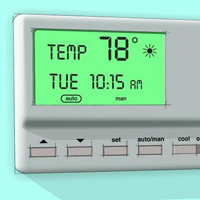
Programmable thermostat

Households that have central air conditioning can do these additional things to ensure that the unit is running efficiently:

  • Install and use a programmable thermostat. Set the temperature for 78 degrees when you are home and warmer when you are away. This will feel refreshing on a hot, humid day.
  • Enroll in utility energy-saving programs, like Xcel Energy's Savers Switch program, to get discounts on summer electric bills.
  • Tune-up your air conditioner. Just like your car, your AC unit needs some TLC from time to time to ensure it is operating efficiently. Cottonwood fuzz, grass, leaves, and dust can accumulate on the coils of your air conditioner causing it to work harder and wear out sooner. You can do it yourself! To learn more about how to keep your AC unit running well, visit the Home Energy Resource MN website.
  • Get an Advanced Energy Audit. Find out how your house is working. An advanced energy audit will provide an evaluation of your home's energy use, insulation levels, air leakage and mechanical systems. Utility companies and private contractors can provide audits; check with your utility or the Minnesota Building Performance Association.

If you are ready to do more to save energy, check out more energy saving tips form the Minnesota Department of Commerce.


Community events and resources

The Do It Green! Directory--available online or in print--is an all-in-one resource for local, sustainable, and green merchants, grocers, retailers, contractors, designers, consultants and other businesses in Minnesota. It is searchable by location and business type. Interested in being a part of the only green business directory in Minnesota? Apply by September 1.

Learn from experts how simple fixes around the house can make a big impact on your water usage at Water Use: Cutting-edge Conservation, July 16, 6-8 p.m., Century College (White Bear Lake).

Get some help with that broken "something" that's been sitting in your closet at the Hennepin County Fix-It Clinics. July 20, noon-4 p.m., North  Commons Community Rec Center (Minneapolis) and August 10, noon-4 p.m., Eden Prairie Senior Center.

The 8th Annual Garlic Fest features fantastic foods, celebrity chefs, marvelous music, area artisans, goofy games…and lots of garlic--all in support of a healthy environment, sustainable farms and vital rural communities in Minnesota, August 10, 10 a.m.-6 p.m., McLeod County Fairgrounds (Hutchinson).


Thank you for reading Living Green 365. This newsletter is a publication of the Minnesota Pollution Control Agency. Please send questions or comments about living green to the address below.

Sincerely,

Britt Gangeness and the Living Green Team   

livinggreen365.pca@state.mn.us      


This email was sent to stan6637.gogreen@blogger.com using GovDelivery, on behalf of: Minnesota Pollution Control Agency 
520 Lafayette Road North · Saint Paul, MN 55155 · 1-800-439-1420